Case study 05 / Property
Ivelle Residences
Ivelle Residences is a website for a luxury apartment tower on the Ikoyi waterfront in Lagos. The tower is fictional. Everything else works: live availability, payment plans in naira and dollars, viewing bookings across time zones, and a sales team that can change a price from a phone and see it live in seconds. I built it to show property developers exactly what they would get, before any of them has to trust me with a real project.

- Role
- Concept, design and build
- Timeline
- Two weeks, October to November 2026
- Stack
- Next.js 16, TypeScript, Tailwind CSS, Sanity, Neon Postgres with Drizzle, Cloudflare Workers, Turnstile, Resend
- Context
- A concept project for my real estate offer. The development, its homes and its prices are fictional
- Live site
- ivelle.chukwumaukaha.workers.dev
The problem
Lagos developers sell homes off plan, to buyers at home and abroad. The price list usually lives in a PDF or a WhatsApp broadcast, and it goes stale the moment a home sells. A buyer in London cannot tell what is still available, what it costs in naira today, or when a viewing would happen in her own time.
Most luxury property sites also look beautiful on a laptop and crawl on a phone, which is where many buyers look first.
So I set myself three things to prove:
- A luxury property site can also be fast on a phone.
- A sales team can change prices and availability, and the site updates itself within seconds.
- Enquiries and viewing bookings are captured safely and reach the sales team at once.

How I built it
I planned the project with Claude, then built it one step at a time in Claude Code. I made the decisions, wrote the brief for every step, and reviewed every change before it went live. Working this way took the build from first commit to launch in about two weeks.
The decisions
1. Build every page ahead of time, and refresh only what changed.
Every page is built in advance and served from the edge, so a buyer never waits for a database. When the sales team publishes in Sanity, a signed message tells the site what kind of content changed, and only those pages rebuild on their next visit. Marking home 4B as reserved shows on the live site in about five seconds. The signature matters. Without it, anyone could make the site rebuild itself over and over.
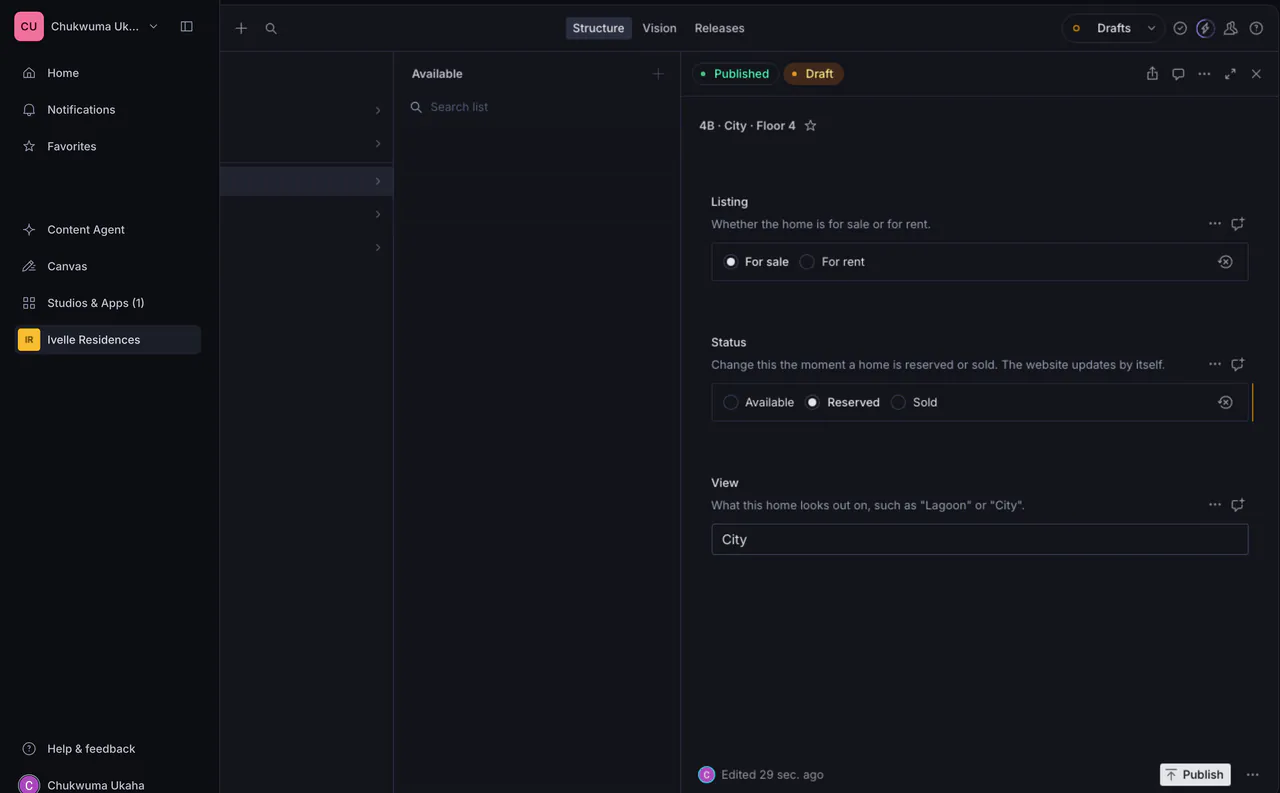
Ivelle's sales team changes a price or a status in Sanity, and the site updates within seconds. 2. Let the database refuse double bookings.
Two buyers can press "Request viewing" for the same slot in the same second. A check in the code is not enough, because both checks can pass before either booking is saved. So the database itself allows only one confirmed booking per slot. I tested it by sending two bookings at the same instant. One was saved. The other got a polite "That time was just taken."
3. Work out every time in Lagos, and show the buyer theirs.
The servers run on world time, and buyers are everywhere. A viewing happens in Ikoyi, so "today", "two hours' notice" and "12:00" all follow Lagos's calendar and clock. At 11:30 at night in London, it is already tomorrow in Lagos. A buyer abroad also sees each slot in their own time, as in "That is 11:00 where you are."
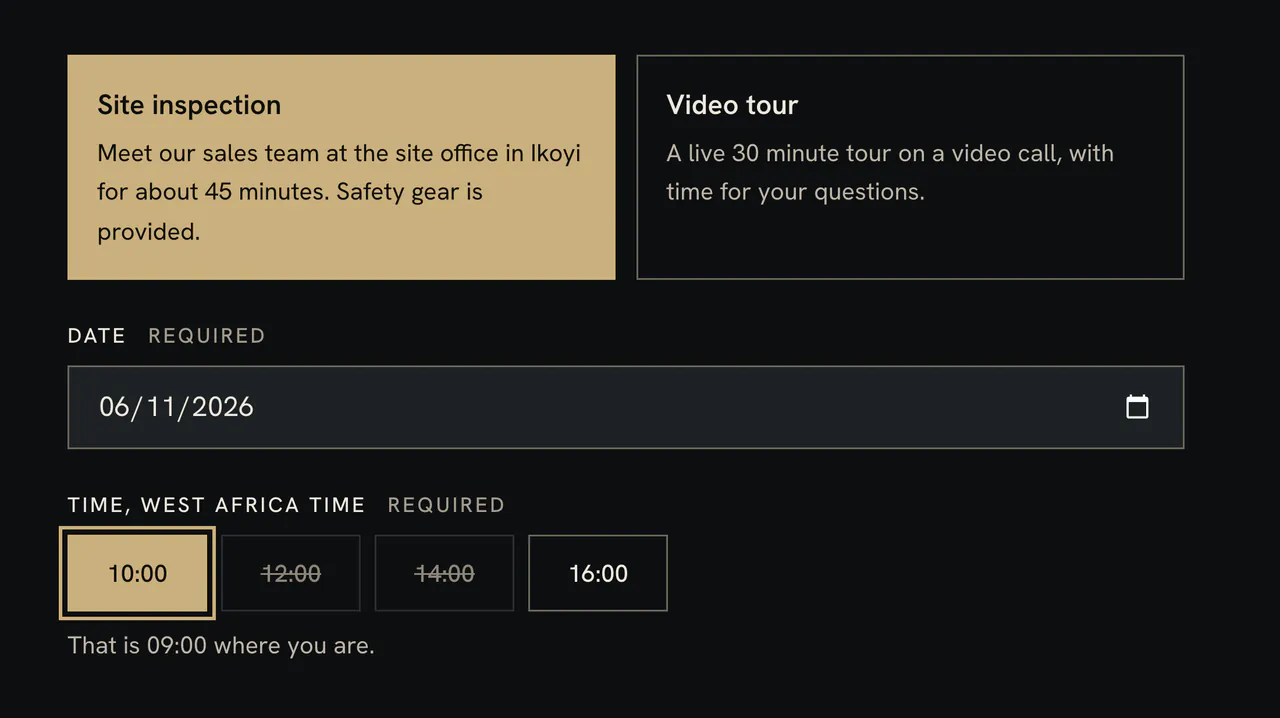
Slots are always in Lagos time, with the buyer's own time beneath: 10:00 in Lagos, 09:00 where they are. 4. Let the browser do the work.
The questions on the buying page open with plain HTML. The menu opens with the browser's own popover feature. The date picker is the phone's own. Each of these works with a keyboard and a screen reader without extra code, and the menu even works with JavaScript turned off. I only write JavaScript for what the browser cannot do.
5. Put the content in the HTML, every time.
During the speed work, one change made the home page look faster on paper and broke it for anyone without JavaScript. Six sections arrived hidden and needed a script to appear. A text search still found the words, so my first checks passed. Now a test loads every page with JavaScript off and checks what a person can actually see.
6. Measure first, and know what the number measures.
The hero image looked soft on phones, even after I upscaled it. Measuring showed why. The phone downloaded a wide image and stretched it 2.2 times to fill a tall box. Giving phones their own tall crop fixed it, at 37 KB on Google's test phone. Later, PageSpeed's Speed Index stayed high after a fix. A frame by frame recording showed the page was fully drawn at 1.6 seconds, and the score was partly an estimate.
7. Keep a demo honest.
Every render carries an "Illustrative render" label, and every construction photo an "Illustrative image" label. A demo bar on every page says the development is fictional. No email ever goes to a buyer, and search engines are told not to list the site.
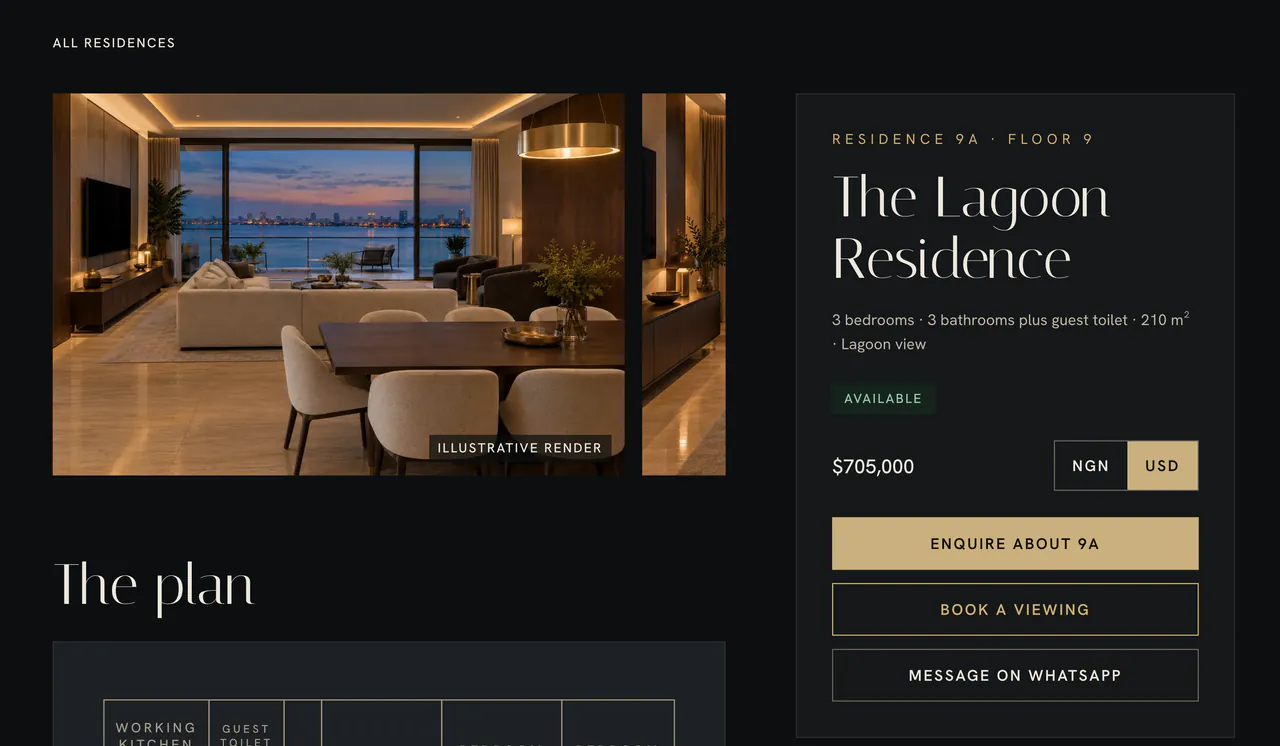
Residence 9A in dollars, its render labelled as illustrative.


What did not work
The home page's main image still loads in 2.7 seconds on PageSpeed's simulated slow phone network, over the 2.5 second target I set. It comes from Sanity's image service over a second connection, and the only big fix is serving it from the site itself. That would break live updates for that image, so I accepted it and wrote down why.
One deploy also stopped halfway and left the old version running, and nothing on the site looked wrong. Now I check one new thing on the live site after every deploy.
The outcome
PageSpeed Insights, mobile, on the live site in November 2026:
| Page | Performance | Largest paint | Blocking time | Layout shift |
|---|---|---|---|---|
| Home | 96 | 2.7 s | 0 ms | 0 |
| Residences | 98 | 0.9 s | 70 ms | 0 |
| A home's page (9A) | 100 | 0.9 s | 0 ms | 0 |
| Book a viewing | 100 | 0.9 s | 20 ms | 0 |
| Construction progress | 98 | 2.3 s | 0 ms | 0 |
Accessibility and Best Practices scored 100 on every page. The site has an A on securityheaders.com and no accessibility violations across 45 pages at two screen sizes. Once the database is awake, viewing times load in about 100 ms. Behind it all sit 435 unit tests and 171 browser tests.
SEO scores 69 rather than 100, because the site tells search engines not to list it. That is deliberate for a fictional development, and it is the only score on this page that is not what a real client's site would get.
What I would do differently
I would give development its own copy of the database from day one. For the first eight steps, my local tests wrote to the same database as the live site.
I would also test on a slow connection much earlier. Taps that got lost on slow 3G only showed up in the final audit.
Want a site like this for your development? See my real estate offer, or write to hello@chukwumaukaha.com.